
hyper-identity
in which I use Chris Fleming as a vehicle to come out to the internet

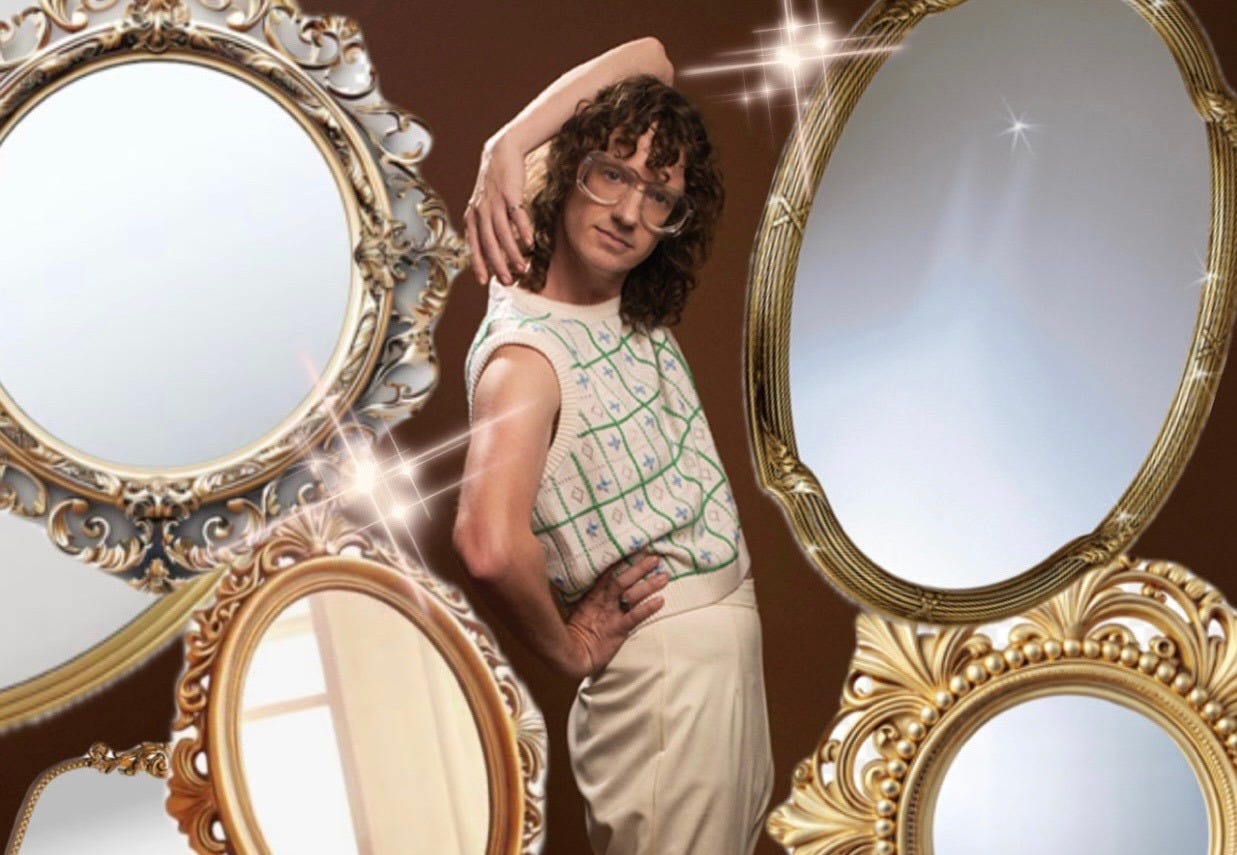
I Could Draw It
On a podcast between comedians Mike Birbiglia and Chris Fleming:
Birbiglia: “I think in one of those specials you refer to yourself as asexual”
Fleming: “No - I make a, I make a joke about the Nissan Cube being-”
B: “Being asexual”
F: “No but I give off that vibe. Clearly, somethings going on. I see what you’re picking up on.”
B:“What do you describe your sexual preference as?”
F: “I don’t.”
B: “You don’t?”
F: “I don’t.”
B:“Do people ask?”
F: “Oh yeah.”
B: “And you say I don’t have an answer.”
F: “Um…yeah…I avoid labels of any kind.”
B: “That’s interesting.”
F:“I mean I could draw you what I’m into, after the show, you know, I could do some sketching. Do you have any charcoal? How much time do you have?”
Who is Chris Fleming? He is probably my favorite comedian, one of the few people for whom I was early on the bandwagon and whose work I will champion for anyone who will listen. He first got famous off his web series “Gayle,” where he plays psychotic suburban housewife who, as the meme goes, runs her family like the navy. Later viral videos include the provocatively titled “Am I a Man?” In which the eponymous question is never answered.
As Fleming says on Birbiglia’s podcast, ‘something is going on here’ with regard to his own gender and sexuality. He dresses strikingly in bright colors, flared pants, and the occasional fur. It might be women’s clothing, but it’s never drag, because he’s not playing a part. He’s performing as himself, a presentation that doesn’t cut against gender as much as moves outside of it. It’s not surprising that Fleming describes identifying labels as “minimizing,” from gender all the way down to mental health language we throw around so casually these days (anxiety, depression, autism, etc.) It’s much more entertaining to say that you live on a ‘hummingbird diet’ of boba and full sugar colas.
Identifiers and labels speak to categories. To be a part of a category is a bit of a double-edged sword. It can be politically useful to be part of a certain category, say ‘working-class’ or ‘victim in a class-action suit.’ Categories allow us to pool our resources and power to affect change. But category can also assign to you attributes and associations that may or may not be true. Categories can also be sticky, and once you belong in one, you might feel obligated to stick with it or else renounce it entirely. This is the trajectory of many ‘anti-woke’ types, who felt the need to define themselves in opposition to what they once were a part of. But it’s difficult to move from categorized to uncategorized.
As an artist, category might be useful to build an aesthetic movement or a school. Futurism, Dadaism, Surrealism - these were all groups that artists self-consciously aligned with. But many artists resented their labels - both Debussy and Monet rejected the label ‘impressionist,’ even if we associate that term with dreamy water lilies and short, mostly diatonic piano pieces. Fleming, in my eyes, is sui generis. He evokes a special response from his audience, a result of incisively crafted routines and masterful crowd work. At his shows, his jokes will elicit a baseline level of laughter, but each one will send 5 or 6 people into piss-your-pants hysterics. You can expect at least one joke that feels made specifically for you (as an example: he has a bit about ‘male violin teachers’ that was almost too much for me to listen to).
I wouldn’t want to categorize Flemings comedy. I want to show it directly to people. In other words, I’d let him draw it.
Tik Tok Made Me Gay
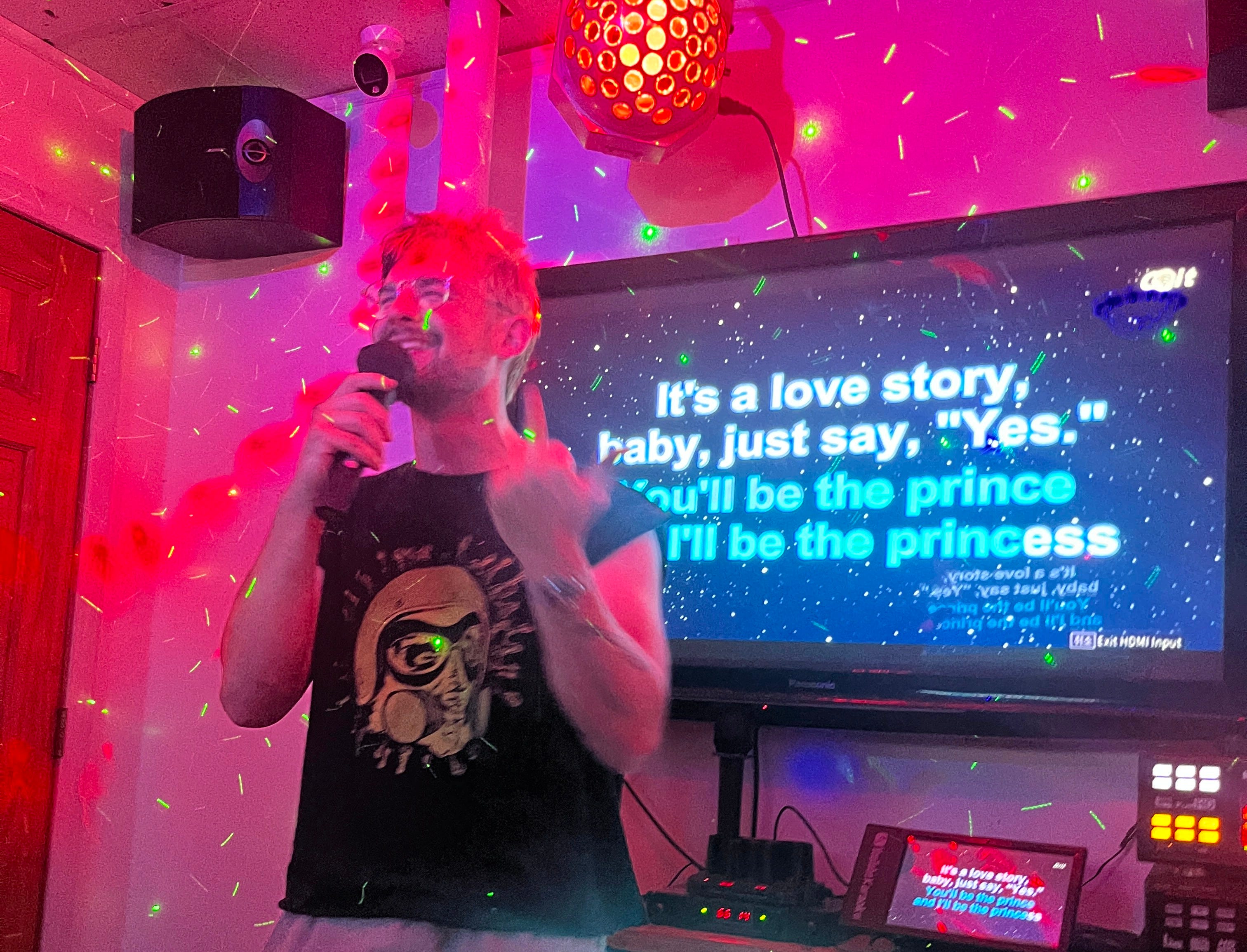
As my 30th birthday approached, I was faced with a dilemma. After a series of painful breakups, a complete exasperation and exhaustion with dating apps, I decided to, you know, play for the other team a bit. “Try dating men,” is maybe the buttoned up way of saying it. But I hated the idea of coming out as bisexual. I hated the idea of ‘coming out’ as anything. As if identity were THE end goal, that once you had all the right terms and distributed them widely, you would be self-actualized. Talking about your sexuality, even to loved ones, seemed hopelessly narcissistic, especially when that sexuality is the worst one.
Oh, the narcissism of the bisexual - wanting a little bit of everything. Not committing to living life in any particular way while insisting on one’s difference, one’s exceptionality. There is only the technical term, not the etymologically and culturally richer expressions of ‘gay’ and ‘lesbian.’ Ultimately, I found it easier to describe factual situations rather than speaking in terms of identity. “I’m dating a man,” was the line, as soon as that was true. Just the on-the-ground truth. Once I realized that most people just accept this at face value, without interrogating WHAT IT ALL MEANS, what contortions of self-understanding and dark nights of the soul I might have wriggled through to get there, I could take a breath. And at the end of it, I realized that there is a power in keeping all that private, anyway.
Yet there’s a bit of selfishness in that perspective, too. Because what finally pushed me to come out to myself (a ridiculous but useful phrase), at the embarrassingly late age of 28, was nothing more than binge-watching the back catalogue of a popular tiktokker. It was the fact that he seemed straight, seemed normal, seemed like me, (and the fact that I was doing this at a sensitive moment in the wake of a breakup) that I was able to ask the question, “what would I lose?” The answer: “only my guilt and my shame.”
(As an aside, this was an extremely humbling experience for me, someone who considers himself intelligent. Kids are figuring all this out at age 14, and it took me twice as long. I’m sure it would have happened eventually regardless, but it was in fact that particular person who opened up the window for me to step through.)
There is utility, then, in a label. As annoying as it is to say, representation kind of does matter. If I could have that effect on someone; if I could turn some innocent kid just a little bit gay, then my work would be done.
But especially as a writer, I’m extremely wary of all this. The reason Chris Fleming is such an important figure to me is not because of his identity, but the opposite. In the words of Wordsworth, he ‘creates the tastes by which he is to be relished.’ I was a fan for years before he was popular, backing several kickstarters and acquiring esoteric merch that I hope one day becomes valuable. But by relentlessly inhabiting his particular world, he found and grew his audience. He himself changed what is funny, and now his instagram reels routinely go viral.
If I was so inclined, I could present myself like this: “Robbie Herbst (he/they) is a queer disabled Jew in diaspora.” People-centric language, please. Intersectional king. This is de rigeur in the world of contemporary literature: basically every aspiring fiction writer flexes their identity. But other than naked careerism, I hope we can agree that this is fucking stupid. Not just because it’s cheugy and cringe, but because it sets your work to the side. By playing the identity game, you trade your claim to art for institutional legitimacy (as long as institutions care about this kind of thing!). Who wants to be a great ‘queer writer?’ I just want to be a great writer.
The problem I’ve always had with intersectionality is that it imagines identity as a kind of iron grid that you impose on the slippery and duplicitous thing called the ‘self.’ When you advertise yourself as a ‘Black painter,’ implicit within that is that your work concerns Blackness; in fact, can only be understood through the prism of race. But surely, this is more true at some times than others. Maybe that prism is always there, but it waxes and wanes in intensity. Intersectionality says that if you can pin all your labels on your jacket, your self and your art will make the most sense. But identity isn’t so stable. And chaining yourself to one can be to ghettoize your own perspective, to deny any insight into the universal.
If we want to get political (and I often do), this is to doom projects of solidarity-building. It can be deployed cynically to undercut the oppressed. It is contra sociality, contra humanism, contra art. It’s pedantic, reductive, and thought-killing. It encourages the sticky-sweet narcissism of internet quizzes and horoscopes, are you a Samantha or a Charlotte, what kind of person are you really, deep down, in the blackest corner of your heart? And attachment style? I have a hunch that this type of thinking leads to many purchases. Identity goes hand in hand with consumption. You are what you eat.
In fact, you are not what you eat. You are what you do. I’m very Catholic in that way (actually half-Catholic, technically). There’s a reason that dark nights of the soul happen at night. It’s because no one wants to see all that. When all is said and done, the sun rises and you can return to the world of the living, to do with your revelations what you will.
Concluding Thoughts on Genre
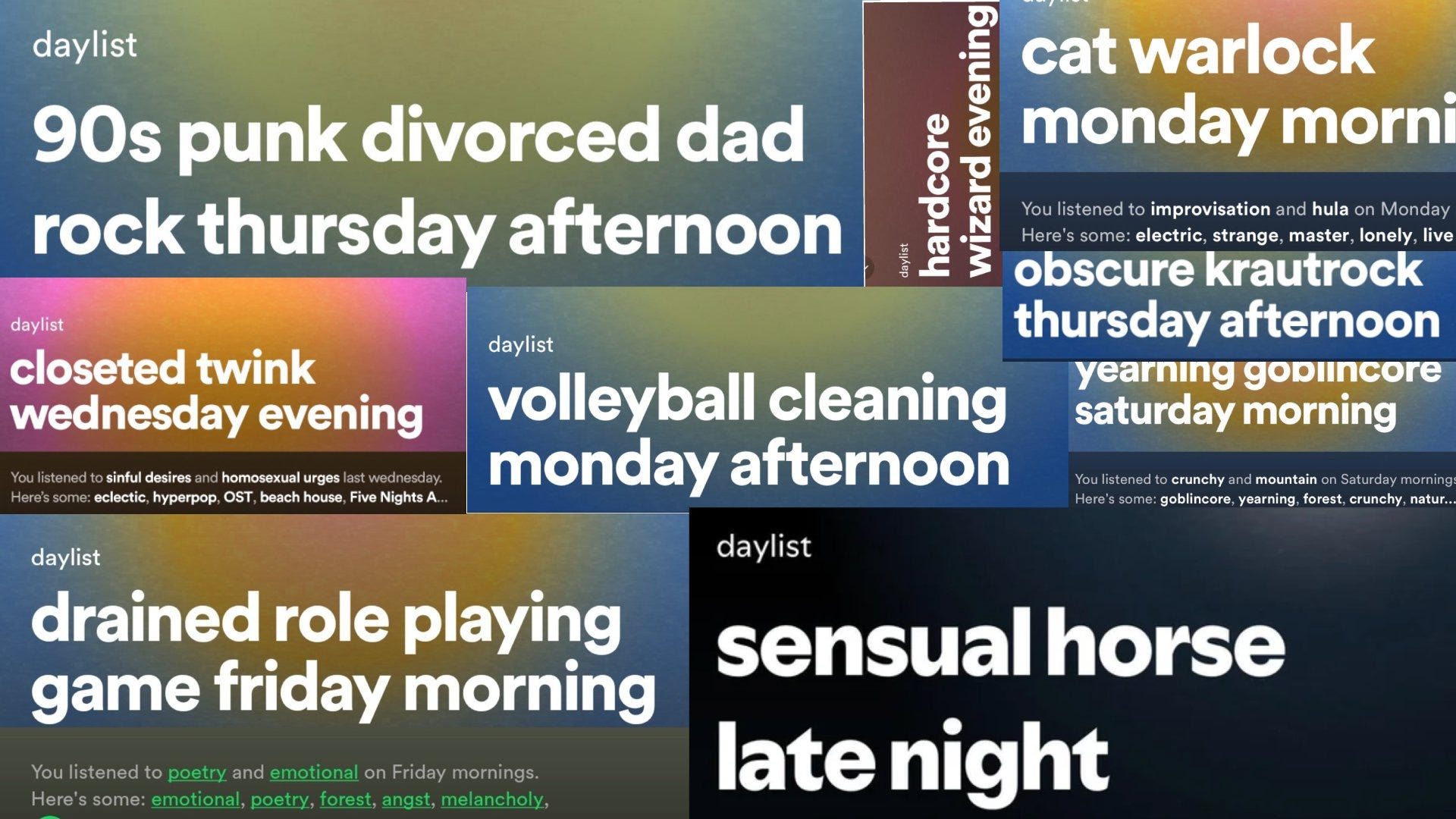
As a musician, the concept of identity is secondary to that of ‘genre.’ Genre is kind of a slippery term - what is, for example ‘adult contemporary’ music? The easy answer: “it’s bad,” but that doesn’t tell us much. What about the very meme-able algorithmic playlists that Spotify spits out? Right now, mine is suggesting “fuzzy grungegaze monday afternoon.” It’s all in lowercase, which feels significant somehow.
There is a feeling that this is different from the sub-cultures of the 20th century. From folk to punk, hardcore to grunge, disco to techno, musical genres used to be synonymous with the people who listened to and made the music. But where are my fuzzy grungegaze friends? What part of the mall do they hang out at? I remember being a teenager and frequenting Hot Topic, where all my favorite bands were on t shirts and a clerk with gauges the size of tangerines might be overheard saying “the new Panic album actually doesn’t make me want to kill myself.” Even then, at the end of the subcultural era, there was a sense of fandom, of musical identity, that felt material and real in a way that now seems totally lost.
In an underwatched Youtube video, Jazz pianist and overall genius Vijay Iyer asks the question ‘what is genre?’ He arrives at the answer that genre is community, the group of artists that listens to each other, go to each other’s shows, have each other’s music stuck in their head when they sit down to write. It seems as good a definition as any. It might mean that Debussy is rightfully an impressionist, whether he likes it or not. That was his scene, after all.
Genre and identity might seem like near-synonyms, but here is the crucial difference: one points to solipsism and navel-gazing, while the other points outward. One is about input, and the other is about output. Fuzzy grungegaze isn’t a stab at an emergent genre; it’s a term of flattery (hard to believe, I know). It is an ego-balm, something designed to tell me that my music tastes are so unique that they could only possibly exist in my own head. It undercuts the very idea of genre, of getting together to make something, because that contradicts the logic of algorithms, which is the logic of Neo-liberalism. This logic says that only the consumer exists, the perfect atom of society. Maybe Tinder will pick up on this too, adding your Kinsey score into a list of highly specific attributes and predilections, a Borgesian infinitude of kinks that no one shares, an eternity of lonely scrolling looking for ‘The One.” tuesday afternoon new-age pansexual findom. saturday morning chillwave heteroflexible. easter sunday eggpunk ace/aro ggg.
Of course, you already know who ‘the one” is. The one is you.
I’m not actually against identity. Identity manifests as self-expression, as sartorial choices, as origin stories, as our deepest ambitions. This thing that I’m against you might term as hyper-identity, a cannibalistic category that eats the notion of category itself. It replaces genre, replaces art, replaces community, with a house of mirrors with You at the very center. It is flags in the twitter bio and lots of mental health-speak and the word ‘toxic.’ It is the trough that holds our digital slop. It is a particularly whining and cynical voice, insisting that you haven’t considered its very special needs, that you might as well not even try. It’s better for us all to just rot in bed. In fact, that’s the only ethical course of action.
You might mistake Chris Fleming for an avatar for hyper-identity, with his cheetah prints and heeled purple boots and jokes about graduate humanities degrees. But what he performs is not identity but genre. A genre that he may be the first member of, a genre without a name yet, maybe, but one waiting to be populated by other people. Because you don’t have to be his same brand of weird to join, necessarily. You just have to get it.
Anyway, I have a bf now and we are very happy.
Brilliantly written and really interesting. I will say I don't think the concept of intersectionalism is to blame - intersectionalism as written in its original political context wasn't about assigning labels, but was about pointing to how the labels other people assign us then affect how we are treated by the state and by communities. It didn't say you needed to claim that identity for yourself necessarily. But if the state deemed you to be disabled, you lacked the same legal protections in work as able-bodied peers. And, in particular, black women lacked the protections women were afforded, as well as lacking the protections black men were afforded, which is what led to the idea of intersectionality being created - to have a framework and a name for looking at that specific experience. I think the modern, hyper-individualistic need to list all your identifiers as a way of selling yourself is a perversion of actual intersectionality. It was supposed to give you a way of talking about your experiences as someone outside the boxes society deemed worth protecting, it wasn't supposed to be a way of assigning yourself a restrictive label you use to sell yourself with.
1. Chris Fleming forever
2. So many lines in this post hit me, esp this one: "There’s a reason that dark nights of the soul happen at night. It’s because no one wants to see all that."