
after drag race
in which I make RuPaul Charles and Jean Baudrillard kiss in the Kohler Art Preserve.

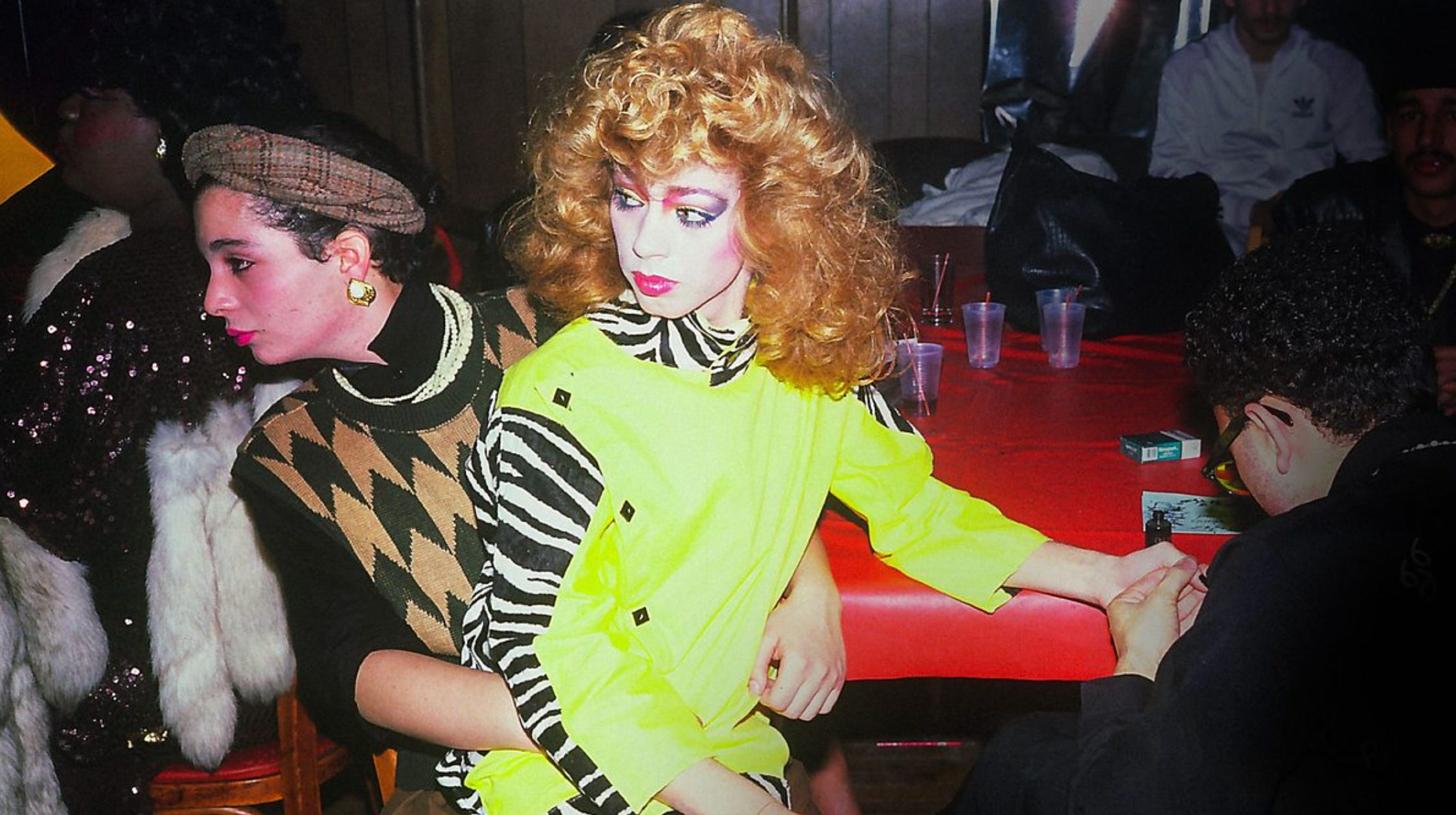
I came to RuPaul’s Drag Race unwillingly, a few months after I’d joined the LGBT fold. I was at the Spoleto Music Festival, and a flock of gay men informed me that now that I was out, I had to watch Drag Race, an hour-and-a-half long weekly reality show. Watching Untucked, the gossip supplement that airs immediately after, was optional but encouraged.
As someone who’s never been big into reality TV, I took my medicine dutifully but wasn’t really convinced. For one, I didn’t really get it on a foundational level. What made one queen better than another? I was informed that Roxxxy Andrews was iconic and cunt, but to me she looked kind of like a 40-something man—other girls were younger and prettier but somehow less iconic. Why were they asked to perform this set of tasks, from telling jokes to sewing clothes to lip-syncing to pop stars? Most alienating was the lexicon of the show, a pride parade stuffed into a set of idioms. I just had to learn all of this now?
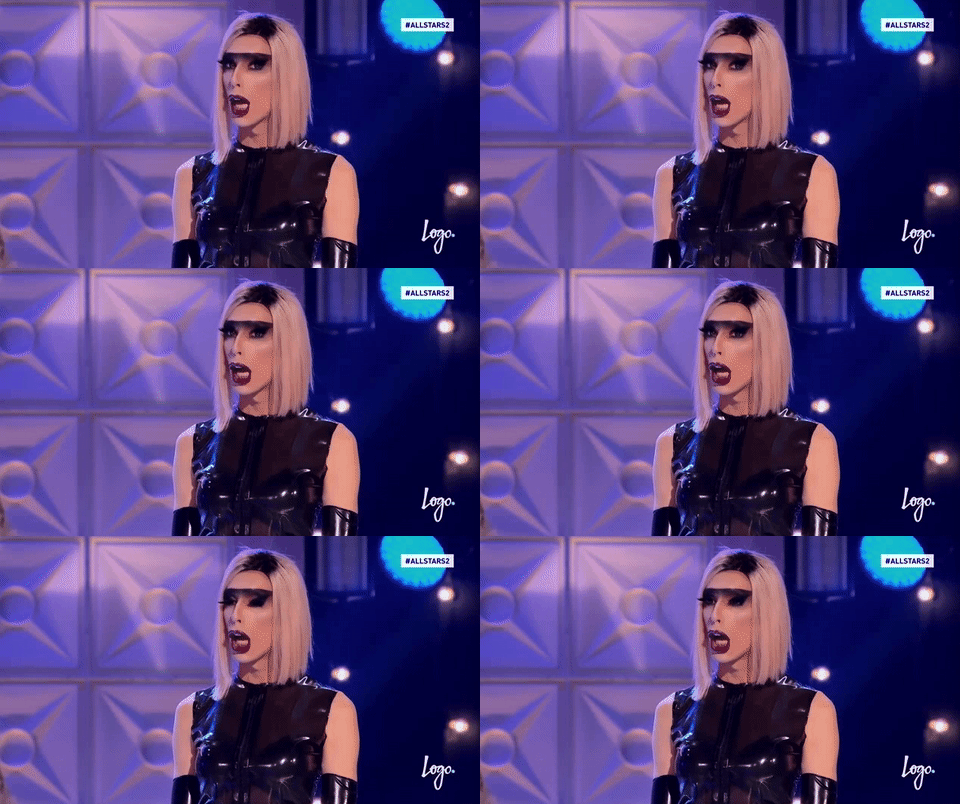
It wasn’t until a year later, when my boyfriend patiently reintroduced me to the show from a friendlier starting point, that I got it. Specifically, it was Alaska on All Stars 2; her latex runway clicked something for me. Not just the outfit, but the way she embodied an idea, a character. I thought about it when I was trying to sleep that night. I couldn’t not think about it. I found I had an opinion about the show, a normative perspective on good drag. It was the same click I hope for out of any art. The splinter in your brain that you pick at until finally you need to do something about it.
That’s what this essay is. Because if I don’t write something, if I don’t make some sense of drag and my mixed feelings about Drag Race, then I would have spent the last 6 months binge-watching a dozen seasons of the show for no reason at all, other than to develop a fully articulated antipathy toward Ginger Minj. And look, I know you are looking at that tiny scroll bar and thinking ‘is he for real?’ Yes, I wrote 3k words about reality TV. Sue me! All I can say is that, if you’re are a fan of the show, stick around for me to finally and conclusively exonerate Nina Bo’nina Brown. If you aren’t a fan of the show, and this seems like some bullshit, well, I’ll at least try to be funny.
Mini Challenge: What is Drag?
If you ask queer people what drag is or why it’s important, you ‘ll get lots of answers about representation, about self-expression, about critiques of gender. But to leave it at that would be to not really take it seriously as an art form, art only having glancing contact with those domains.
Of all of those, self-expression feels the most misleading. For one, many drag queens describe their drag as an effort to move beyond the self. Jinkx Monsoon describes her drag persona as a sort of armor. Pearl was a cartoon character that Matthew James Lent drew as a child, until Lent one day decided to dress up and become his own invention. Famously, Trixie Mattel took her name from the bespoke slur her homophobic stepfather called her as a teen. It is these twin through-lines: transformation and resistance, that elevate drag as art. ‘Self-expression’ doesn’t quite get to the essence of drag, which is using the self as a canvas. What hooked me on drag was the type of commitment it entails, the inherent riskiness of the endeavor. Drag artists quite literally have skin in the game. This is why it can be so thrilling.
Drag is the last art form that is reliably transgressive in 2025. Even as the reality franchise grows more rote, the political significance remains hotly contested. Drag performances continue to be banned or outlawed across the country and the world.
Drag is often explicitly political, and Drag Race the show makes no bones about this. RuPaul has hosted both Nancy Pelosi and AOC on the show. Season 12 was basically a massive Get Out the Vote effort (and a big oopsy #metoo scandal but they edit that all out). When queens are asked why they should be the ones to be crowned champion, they often refer to the political stakes at hand. Yet in all of this, the relationship to performing exaggerated femininity on TV and our desired political goals is glossed over. I return to my original question: what is drag, and what does it do? From there, we might understand how it’s political, and why RuPaul’s show typically falls short of its potential.
Maxi Challenge: What is Drag pt. 2 (French)
I’m going to use Jean Baudrillard’s essay “The System of Objects” to excavate certain aspects of both the art form and the reality TV show that has basically consumed it. This is not only because I’m a serious intellectual, but because I think they share a common DNA.
Baudrillard was a post-modern Frenchman active in the final quarter of the 20th century. Like many critical theorists of his generation, he grappled with the fact that Marx had predicted the fall of capitalism a century prior and, nevertheless, the bitch persisted. The most recent revolutionary incarnations—the New Left and the associated social movements of the 60s—had burned out by the mid-70s. Ronald Reagan was on the horizon. The revolution seemed far, far too late.
Baudrillard developed a critique of consumer society that will be familiar to even my most illiterate readers (I’m just kidding—you’re all beautiful). He saw the rise of television and advertising as heralds of a consumer culture in which commodities become more than ends to satisfy needs.
Consumerism speaks to urges above and beyond, say, your need for a car to drive around your new suburb. No—your car says something about you, the kind of person you are, your place in the community. In this way, consumer goods are a sort of debased language, signaling vague notions of status to others. Of course, purchasing the car is purchasing an empty promise of fulfillment; in short order, you’ll feel compelled to purchase another car, for whatever urge drove you in the first place remains stubbornly unsatisfied. He writes of the impossible dream of purchasing your way to perfect self-expression and self-actualization. In reality, consumerism locks you in an illusion of freedom, a fantasy that choosing between toothpaste brands is the same as being meaningfully free. Basically, this is the philosophy of any cult movie released in 1999.
Of course, any student of Drag Race will tell you that feeling the fantasy is one of the highest ends of drag. In fact, a lot of Baudrillard’s theory could describe drag. The difference being, where Baudrillard imagines (I’m interpolating here) a middle-class professional in the western world, Drag takes for her subject the most marginal of that same society. As a matter of fact, Harlem Ballroom culture (the immediate predecessor of modern drag, in which queens would compete in ‘balls’ where they would model certain categories, ‘read’ one another, and have dance battles known as ‘vogueing’) arose in the late 70s and early 80s, precisely Baudrillard’s milieu. That same consumerism compelled broke gay and trans people to shoplift luxury goods from department stores which they’d later model in balls. Of course, the meaning is totally different in the two instances. Drag used that same degraded consumer language to protest and undercut the system that oppressed its participants. ‘Executive Realness’ allowed queens to prove that they could be executives if given the chance. These were the same executives, of course, engaging in Reagan-era corporate consolidation, symptomatic of the neoliberal regime that made the queens destitute in the first place.
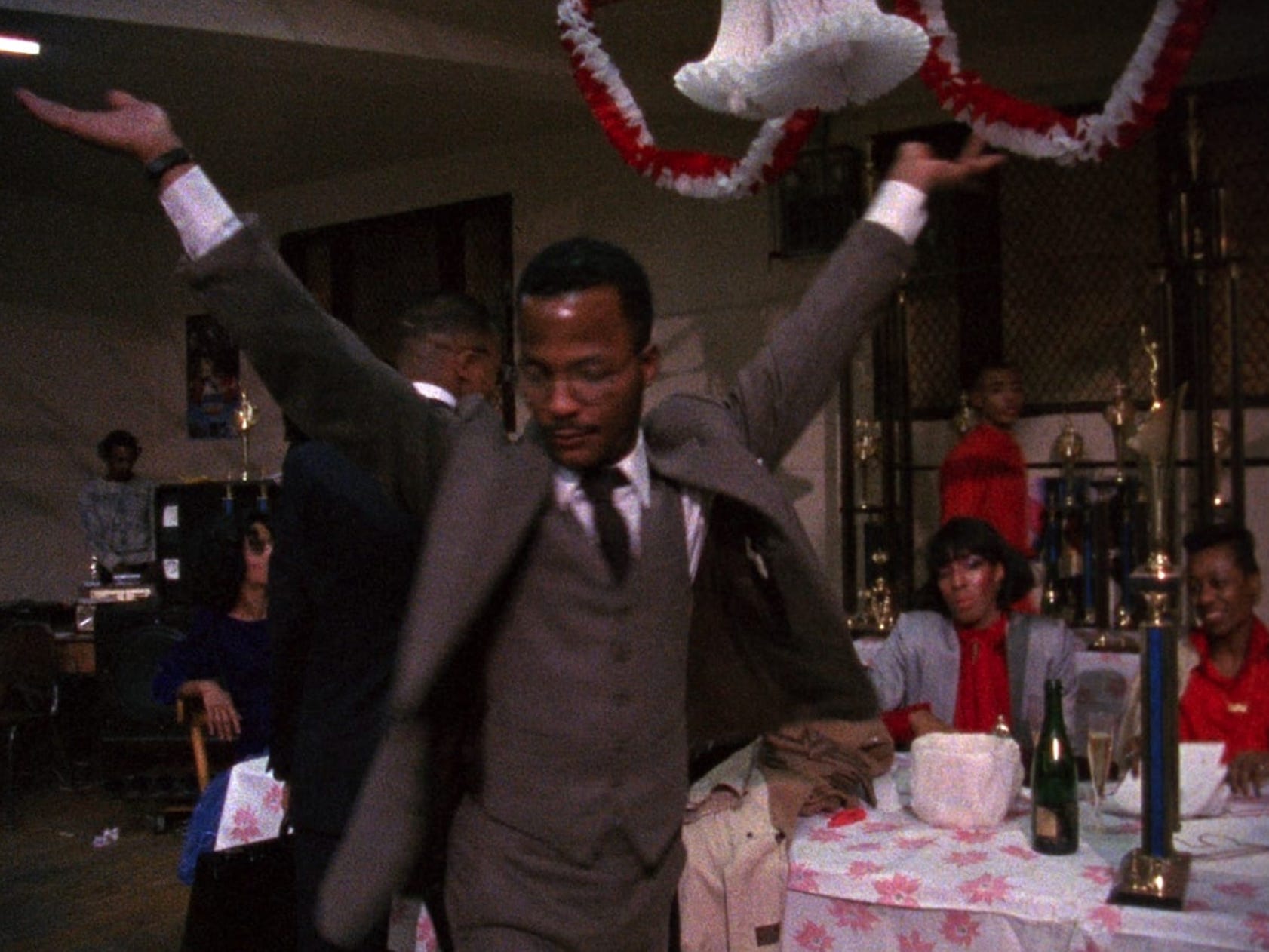
Drag only makes sense in a consumer culture, and its prime function is to strike against the unjust world it emerges out of. Baudrillard started his career trying to update Marxism, and he ended it completely black-pilled about the prospects of revolution in a society made stupid by consumerism. But perhaps he would have felt different in a ballroom, and perhaps he wouldn’t have abandoned Marxism if he didn’t focus on bourgeois society. As trenchant as his theory can sound, don’t forget that most people aren’t buying automobiles to signal their status to the household next door because most people don’t have cars or houses.
Runway: RuPaul Baudrillarles
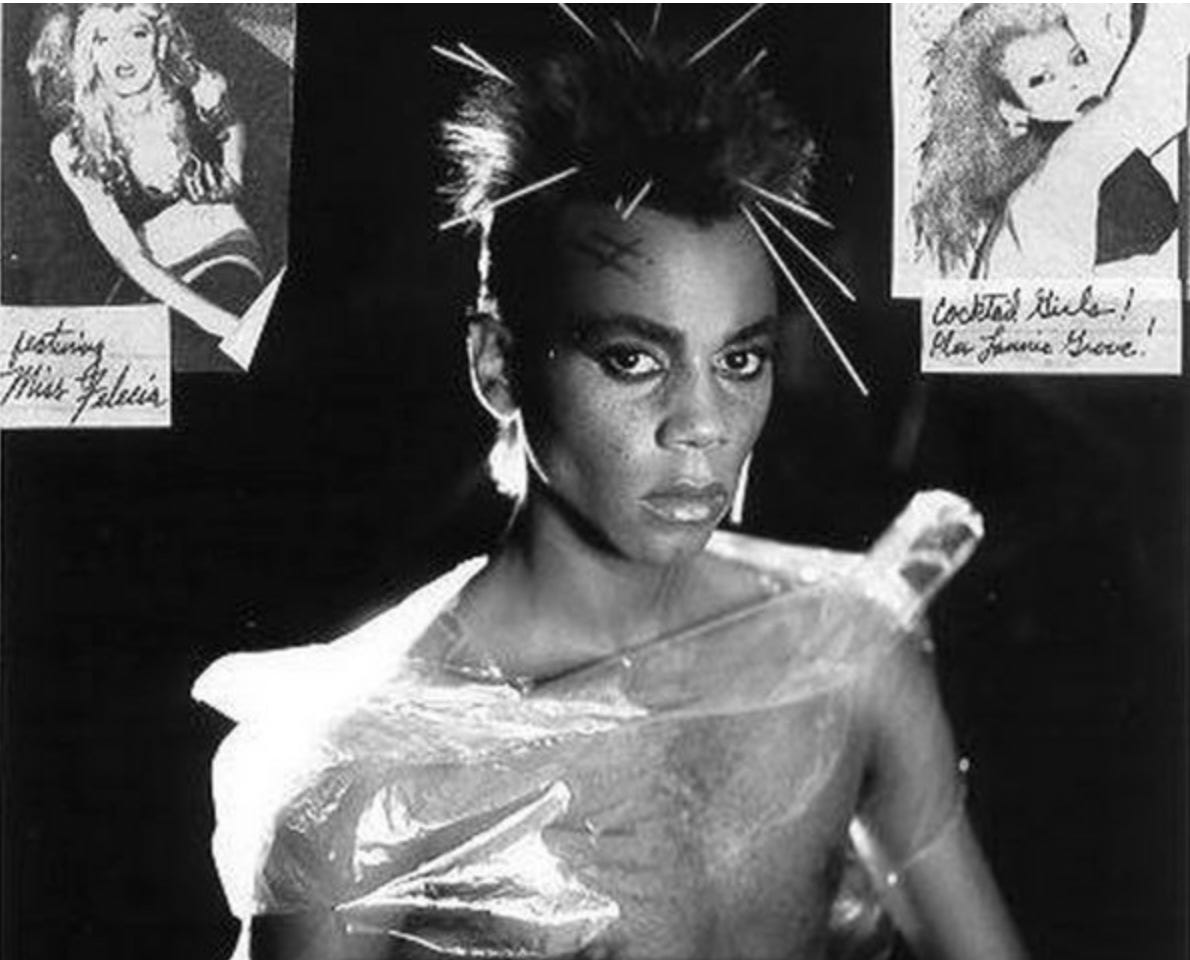
Let’s get to the main course: RuPaul Charles. Ru came out of the Atlanta drag scene as a gender bending scenester, staging provocative productions in which he might come out on stage dressed as a slave. His style at the time—he described it as ‘Black Hooker’ in his New Yorker profile—evolved substantially when he made a play for the mainstream. Among Ru’s idols are Donna Summers, who intentionally crafted her image to be acceptable to white audiences. Accordingly, Ru’s television career presented a much less challenging drag, a fair compromise, perhaps, for the leaps in drag visibility he earned with this adjustment.
We now live in a time where drag has never been more visible. The Drag Race franchise is unbelievably sprawling, with versions in over a dozen countries and a dizzying catalogue of spinoff shows on the home network, World of Wonder (who is watching the Cherry Valentine show???). And yet the politics of visibility, much like the politics of equal rights, has never seemed quite as limited. Visibility, of course, can cut both ways. It can create mass acceptance (the popular explanation for the success of marriage equality), but it can also cause reactionary backlash. I would wager this is especially true when drag fails to center the conditions that led to its rise: not just political marginalization, but economic destitution amidst the ravages of consumer society.
The Drag Race riposte is, of course, more consumerism. On Drag Race, becoming a brand is explicitly the goal. Even before the rise of social media, queens were asked to brainstorm ways to market themselves. This is, of course, a response to the economic reality that they have to become quite popular to make a living—there aren’t a lot of adjacent careers to fall back on.
There is an interesting tension though between the economic and artistic imperatives. The goal on the show is to present the illusion of fashionable and opulent women who wear lux brands, but often through custom outfits made out of raw materials and essentially garbage. Here, you see the artistic roots of the show: making something from nothing. Famously, when a queen owned up to wearing H&M on the runway, she earned an unusually enraged response from RuPaul. Certainly, the degree of outrage is higher because it’s fast fashion, but wearing any branded item (regardless of the brand) without 'elevating it’ is verboten. Drag exists in reference to consumer culture, but if it doesn’t exceed it, it’s not really drag.
There’s a long running joke that Ru turns everything into a branding opportunity for herself, and it’s true. The queens on the show have a symbiotic relationship with the RuPaul brand; the best thing you can hope for is to come up with a catchphrase that makes it into the ever-expanding lexicon of the show. The memes are so central that Ru will sometimes have queens act out the iconic origins of these catchphrases, building the self-mythology that sustains the colossal franchise. It’s something straight out of Baudrillard, who describes the sub-language of brands as operating purely on affect or, in modern parlance, vibes.
Many of the queens on Drag Race are working class, yet the show remains strangely tone deaf to any effect this has on the actual production. Chi Chi DeVayne, a poor Shreveportian, received the judge’s ire in season 8 when she claimed she couldn’t afford the opulent gowns of the other girls. In later seasons, it became normal for queens to go tens of thousands of dollars into debt to finance the gaggy outfits they need to even compete. Drag Race isn’t exactly enacting economic redistribution, even for its competitors.
The compulsion to make everything a meme doesn’t mix particularly well with the show’s hunger for trauma narratives. Take the aforementioned Roxxxy Andrews, who, in an intense moment, admits her mom abandoned her at a bus stop when she was three years old. This is played as a heartfelt ‘trauma’ beat in her first season, but it becomes a meme by the time she returns for All Stars. Soon, the shorthand of being ‘left at the bus stop’ becomes a reliable laugh line.
Some of that is the black humor (why’s it gotta be black?) characteristic to drag, arising from the bleak backgrounds of many practitioners. But a lot of it is just the show’s constant churn of trauma into Emmy-bait into meme, with queens often outdoing each other in the Werk room to cry about their tragic pasts, surely at the prodding of producers. In the Ru cosmology, the ultimate objective of oppression is monetization; money heals (heels?) all wounds.
The apotheosis of this worldview is the ridiculous politics of Ru herself, who is happy to turn the show into an arm of the Democratic Party while simultaneously building out the bunker on her 60,000 acre ranch in Wyoming. In response to criticism that she also fracks on her property (!), Ru can’t take the heat, asking the haters if they do not themselves use oil from fracking. An excellent response, seeing how we are all very able to choose the energy sources that power our basic existence.
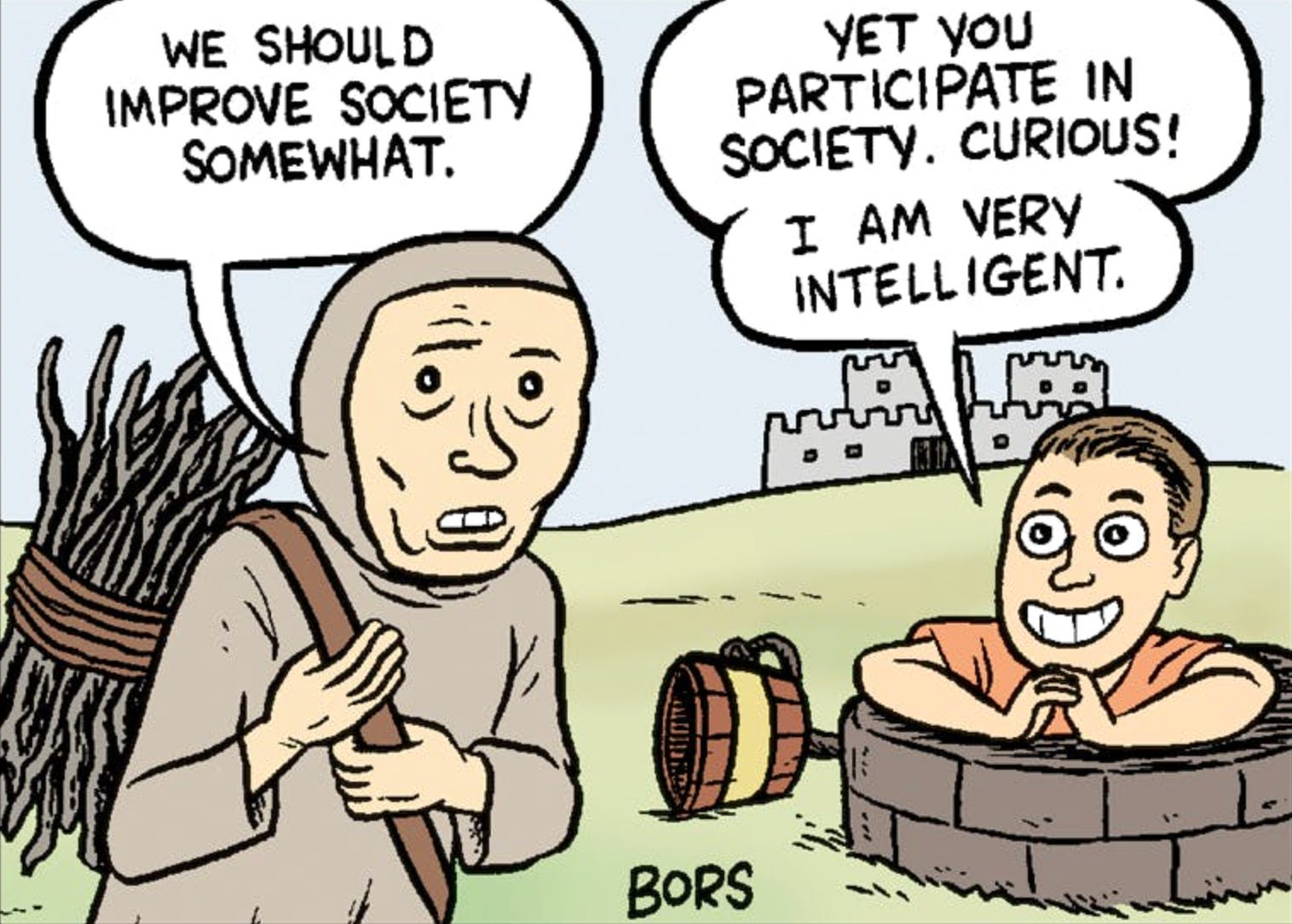
It’s all part of the reason that the marketing of season 18, in which drag is a ‘light in shady times,’ rings so hollow. Is drag political or not? What has it done for us lately? Sasha Velour lip sank to '“So Emotional” five months into Trump’s first term. If that couldn’t move the needle, then what could?
Drag Race feeds on the foundational trauma of the art form, glutting itself on a ‘healing’ narrative that doesn’t ever really heal. It does, however, make some people very rich. Moreover, it’s good TV.
Lip Sync: The Velour Method
I’m probably overstating my case in this critique. After all, I still watch the show, don’t I? Despite the Baudrillard of it all, there are genuine moments where the veil is pierced, where the world is changed by what happens on screen.
I mentioned the Sasha Velour lip sync (season 9 finale), and it’s worth dwelling on this a bit more. This is where you do need a bit of an understanding of the show (and the storyline of season 9) to get the full significance. Nevertheless, I think the video stands on its own. If you have two minutes, I’d really suggest you watch it.
Velour performs against Shea Coulée, the clear favorite to win the crown. Sasha has put in a solid but hardly dominant performance this season. She’s eclectic and artsy—not the type to typically win. Importantly, she’s never had to lip sync for her life, so no one knows what to expect.
Velour, who performs bald in homage to her mother who died from cancer, emerges in a red wig. As the music starts, she rips petals from a rose in rhythm. Throughout the performance, Velour portrays the song as an unbearable lovesickness, her awkward and jerky movements contrasting to the smooth and ever-polished Coulée. She removes gloves from which burst even more rose petals, then crawls on the ground in the mess she’s made. In the climactic moment, she takes her very wig off, releasing a torrent of petals. Total gag. It’s one of those moments of transformation that stops your heart for a second. Velour taps into the madness at the root of what might seem like a breezy pop song, the decadent and excessive nature of unrequited love, something so ugly and beautiful that all you can do is take your wig off.
To be clear, this moment wouldn’t exist without the show itself. The competition format inspires a certain type of performance from the queens. In the worst instances, it’s rank desperation, with girls doing the splits over and over in the hopes of impressing Ru enough to stay in the competition. But in the best cases, there’s a sort of transcendence. It has the markers of all great art.
Untucked at Kohler Art Preserve
This summer, I took a trip to the Art Preserve at the Kohler Art Center in Sheboyagan, Wisconsin (yes, Kohler like the toilet brand). The collection specializes in site-specific art installations. Basically, it collects works of a particular model of artist: one who dedicates most of their life to an idiosyncratic art form and almost obsessively fills their homes with their creations. These are outsider artists, making works out of some hidden compulsion. Wandering the museum—which was practically empty when I was there—you are confronted with that fundamental question: why do people do this? What drives these obsessions to the point that we would overrun our house with millenarian hand-painted signs or uncanny humanoid statues?
In the Baudrillard section, I discussed the consumerist deception, in which an urge is steered into a fixed grid of consumer options, like Indiana Jones swapping the treasure with a stone of similar weight. We all end up buying the same mass-produced items, but those nameless desires that drove us to hit the ‘Buy Now’ button are quite individual.
If drag was originally a deft counter to hollow consumer culture, these installations feel like an important addendum. Humans are mysterious and compulsive creatures, and what better representative than Nek Chand, the Indian artist who spent twenty years scavenging discarded materials to build a kingdom of immortal beings? Just like consumer culture, art can never fully satisfy those drives (toward self-expression? toward creation? toward some higher state of being?), but it at least moves forward, builds upon itself, ventures into the unknown.
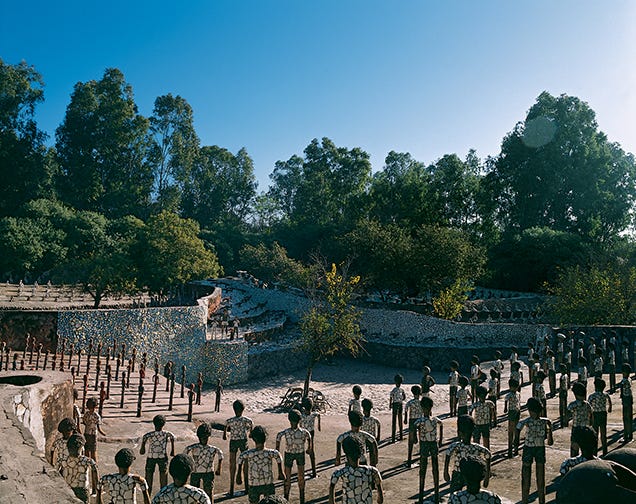
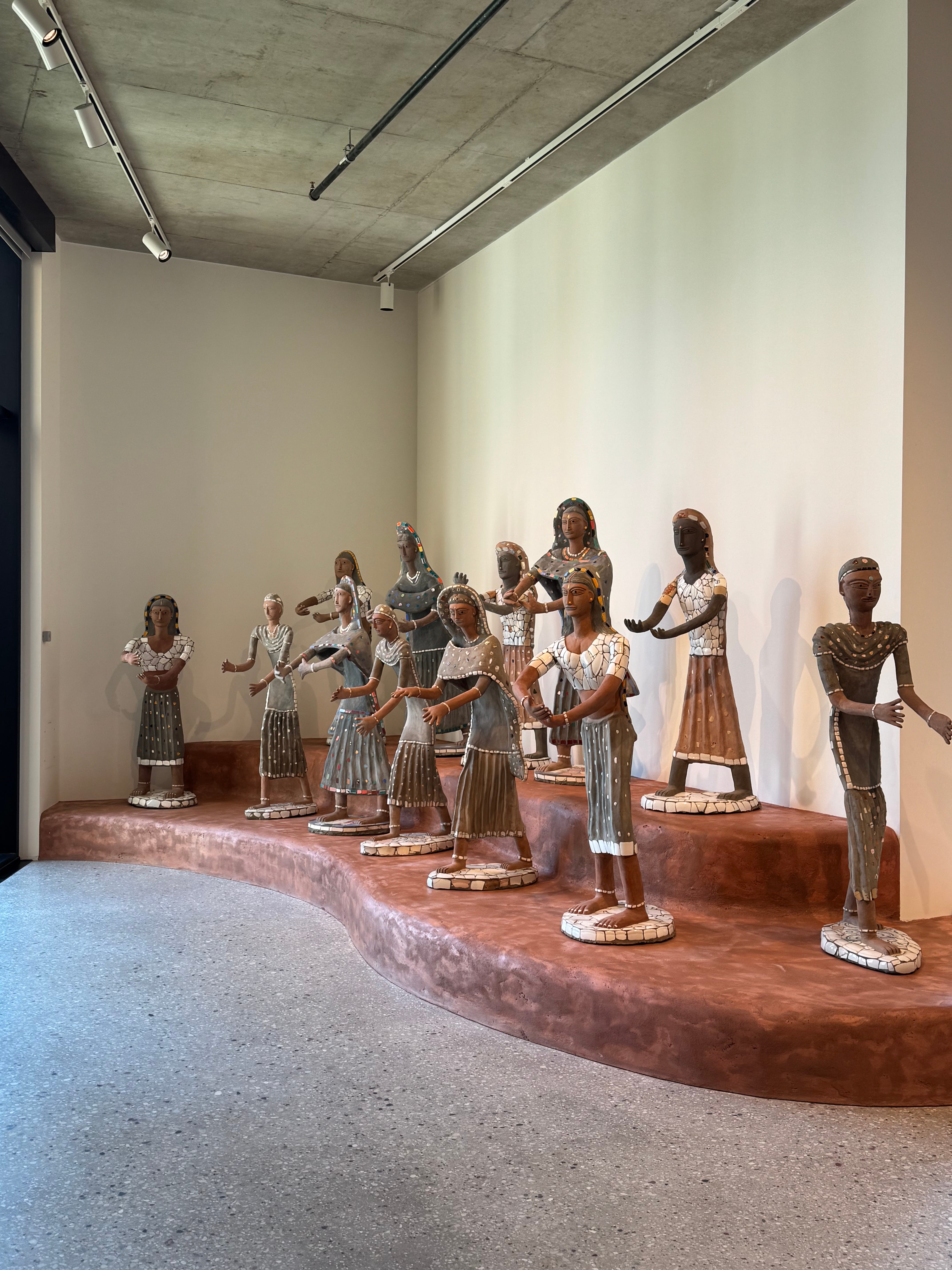
Importantly, many of the Arts Preserve installations came originally from private residences. Much like how drag uses one’s body and one’s identity—those things closest to who we are—these artists used their homes as canvas or meta-canvas. They, too, have skin in the game.
In the museum, it’s impossible to ignore the work of Dr. Charles Smith, whose sculptures are presented in counterpoint to the Chand Rock Garden works. But where Chand imagines utopia in the kingdom of heaven, Smith deals with our more hellish terrestrial reality. What started as a memorial for a fallen friend in Vietnam transformed, between 1986 and 2000, into the African-American Heritage Center, with over 600 sculptures crowding his Aurora, IL home.
While his work takes as its subject the whole scope of Black liberatory struggle and oppression, the sculptures themselves can look like a minstrel show, with grotesque stereotypes repeating in what seems like a painful compulsion.
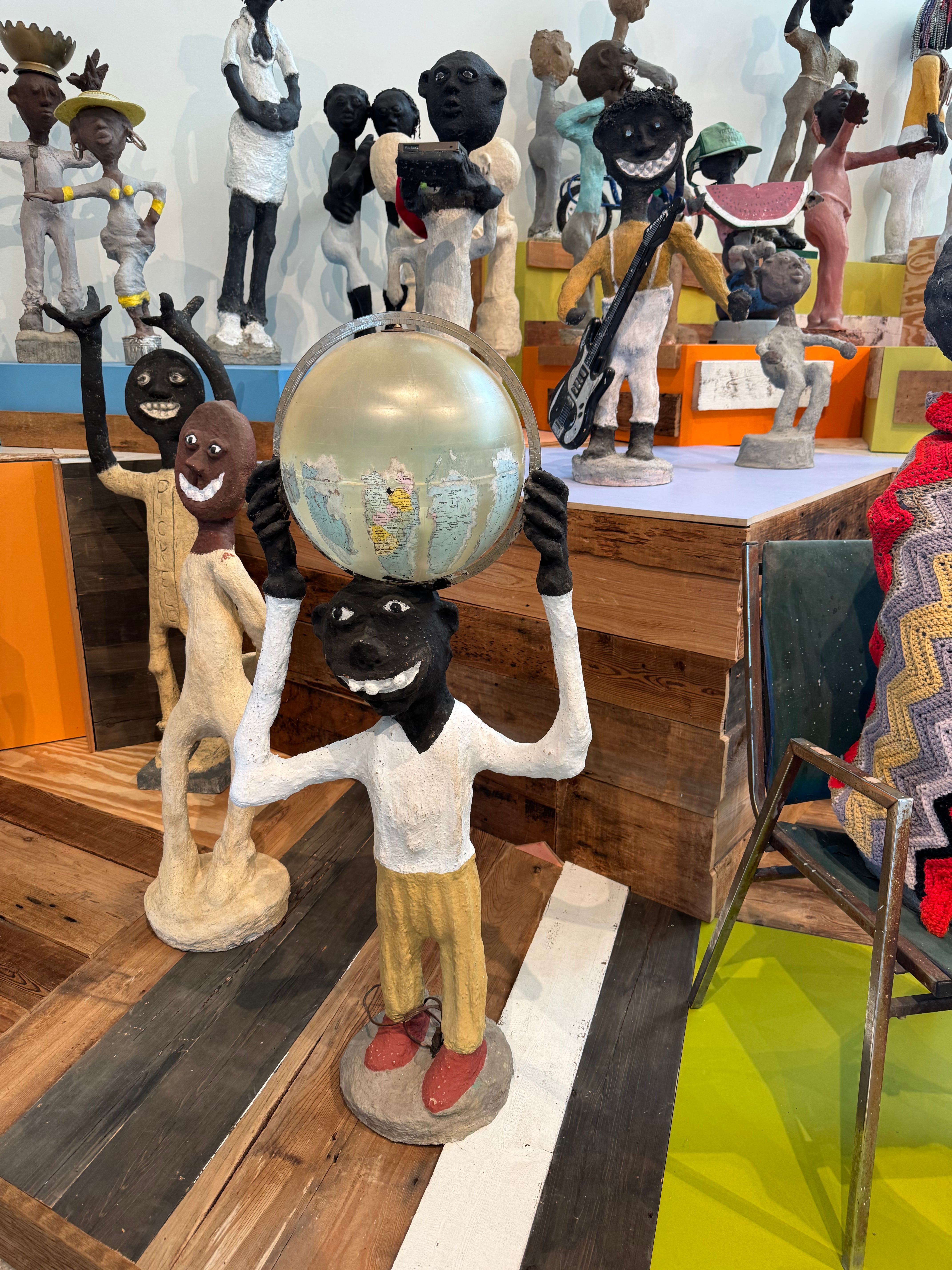
Smith’s work transgresses in a similar nature to the original Harlem Ballrooms, appropriating the visual language of oppression. These figures crowded his property and his home. One is forced to wonder about the blend of obsession, inspiration, and longing, that would power a project like this.
This is art lacking the normal distance or disavowal of the museum space. It strikes much closer to the heart, and it speaks more powerfully because of it. Here, then, is a reminder of the power of truly transgressive art. Something I think drag might need.
Will meaningful political action come out of Drag Race? To be sure, many queens from the show are themselves quite political. But the series itself is doomed to a Baudrilliardan death loop, a closed system of pseudo-language instigated by and in service to branding, a shallow politics of representation, and the RuPaul Charles fortune and legacy. It does not escape the consumerism that birthed it. #DragRace
I have the sense that this essay is a bit untimely. What can I say—I’m doomed to be late to the party! I got hooked on seasons from over a decade ago, and there hasn’t been a good scandal in years. But as far as I can tell, no one has written about this yet, so here it is: my dragnum opus. As we face down an 18th season from the flagship show and an ever-metastasizing Drag Race universe, I think it’s worth remembering what drag is and where it came from.
I lied at the beginning — I’m not going to try and exonerate Nina (I’m not crazy!). But some of you probably got excited! Think of it as my own little transgression, like the thrill of a risky runway look, or Chi Chi’s pearls raining to the ground at the height of “And I’m Telling You I’m Not Going.” Of course, the game I’m playing doesn’t register in the same way. Drag, not Substack essays, is the only art form in 2025 that can still shock, that faces sustained political opposition, that registers (for better or worse) in the public imagination. Politics and art are inseparable in drag. For that reason, we should probably hope for more.
It’s possible that the future of drag isn’t a reality show. I’m not the one to offer innovations—I’ve rarely ever sashayed and only shantayed once or twice. I’m just a humble fan. But we are still waiting for the first promise of drag to be fulfilled: to turn the garbled language of oppression against itself; to build real power for the powerless.
This essay perfectly captures what makes Drag Race so compelling—and so frustrating. Your self-awareness about still watching despite your critique is what gives this piece such depth. The tension you articulate between Drag Race's commercialization and the genuine moments of transcendence (Sasha Velour's lip sync) is exactly what we should be talking about. You're right that the show falls short of drag's revolutionary potential, but the fact that even within its constraints there are moments of real magic proves drag itself is still alive. The Kohler Art Preserve comparison is brilliant—both drag and outsider art are compelled by something beyond commerce. Hope your dragnum opus inspires more critical conversations like this.